
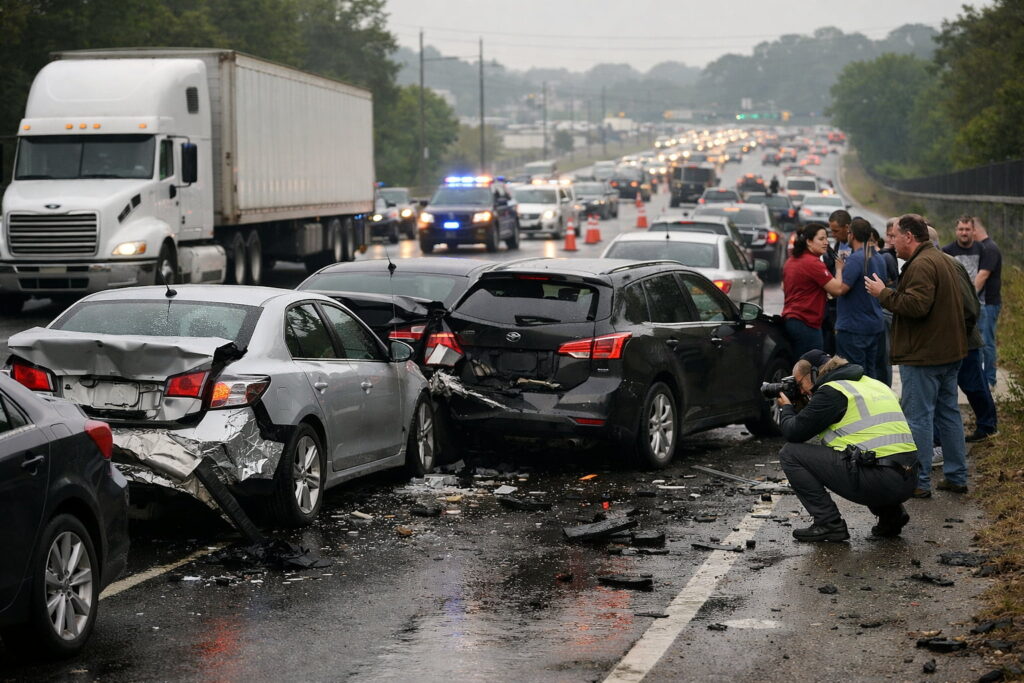
Determining multi-car accident fault in Georgia becomes far more complex than standard two-vehicle crashes. When four, five, or six vehicles collide in rapid succession on Gordon Highway, identifying who caused what damage transforms into a puzzle that multiple insurance companies interpret differently. Each driver points fingers at someone else while adjusters conduct separate investigations that often reach conflicting conclusions.
Gordon Highway’s daily congestion near Fort Eisenhower creates conditions where chain-reaction collisions occur with frustrating regularity. The mix of military commuters, commercial trucks, and civilian traffic produces sudden braking patterns that catch drivers off guard. A single rear-end collision quickly cascades into a multi-vehicle pile-up as following drivers fail to stop in time. Sorting out liability in these situations requires methodical evidence gathering and a clear understanding of how Georgia law assigns fault when multiple parties share responsibility.
Key Takeaways for Multi-Car Accident Fault in Georgia
- Georgia’s modified comparative negligence rule under O.C.G.A. § 51-12-33 allows recovery only if your fault is 50% or less, with compensation reduced by your percentage of responsibility.
- The driver who initiates a chain reaction doesn’t always bear sole fault, as following drivers may share liability for following too closely or failing to maintain a proper lookout.
- Multiple drivers frequently share responsibility in pile-ups, with fault percentages distributed among several parties based on each driver’s contribution to the collision.
- Physical evidence from vehicle damage patterns tends to be more reliable than conflicting driver accounts when reconstructing how a chain-reaction crash unfolded.
- Police reports provide starting points but don’t bind courts or insurers, so independent investigation may change initial fault assessments.
Why Gordon Highway Produces Complex Pile-Ups
Gordon Highway’s specific characteristics create conditions that transform simple rear-end collisions into multi-vehicle incidents. Drivers familiar with this corridor recognize its patterns, while those unfamiliar with it can find themselves caught in sudden traffic compressions.
The Fort Eisenhower Traffic Factor
Military installation traffic creates predictable but intense congestion patterns. Morning gate openings and afternoon releases produce traffic surges that ripple along Gordon Highway. The mix of civilian commuters and military personnel who may not be familiar with the local road conditions introduces an element of unpredictability to the traffic flow.
The road’s design doesn’t accommodate these volume fluctuations gracefully. Lanes merge and diverge in ways that force last-minute decisions. Drivers accelerating to highway speeds suddenly encounter stopped traffic near interchange approaches. These transitions create the sudden braking events that trigger chain reactions.
Commercial Vehicle Presence
Freight traffic along Gordon Highway includes tractor-trailers serving Augusta’s commercial areas. Large trucks require significantly greater stopping distances than passenger vehicles. A fully loaded commercial vehicle traveling at highway speeds may need 400 feet or more to stop completely.
This stopping distance differential creates dangerous situations in sudden slowdowns. Passenger vehicles brake successfully while following trucks cannot stop in time. The resulting impacts push smaller vehicles into cars ahead, distributing damage across multiple vehicles and complicating fault determination.
Weather and Visibility Challenges
Augusta’s weather patterns contribute to Gordon Highway pile-ups during certain conditions. Morning fog reduces visibility during peak commute times. Afternoon thunderstorms create slick surfaces that extend stopping distances. Sun glare at particular angles blinds drivers approaching certain curves.
These conditions don’t excuse negligent driving, but they affect how fault gets evaluated. A driver who follows too closely in clear conditions commits the same technical violation in fog, but the consequences differ dramatically. Weather-related pile-ups often involve more vehicles and more disputed liability than clear-weather crashes.
How Georgia Law Handles Shared Fault
Georgia’s approach to negligence directly affects multi-car accident claims. When several drivers contribute to a pile-up, the law provides a framework for distributing responsibility and calculating compensation.
The 50% Threshold Rule
Georgia follows modified comparative negligence under O.C.G.A. § 51-12-33. This rule bars recovery for anyone bearing 51% or more fault for the accident. Drivers found to be 50% or less responsible may still recover, although their compensation is reduced by that percentage.
In multi-car pile-ups, this threshold creates high stakes for fault determination. A driver found 45% responsible recovers 55% of their damages. That same driver found 51% responsible recovers nothing. Small differences in fault allocation produce dramatically different outcomes.
Distributing Fault Among Multiple Parties
When multiple vehicles collide, fault rarely concentrates on a single driver. The first driver who braked suddenly may bear some responsibility. The second driver who followed too closely likely shares fault. The third driver who was texting contributes additional negligence. The fourth driver was speeding and couldn’t stop in time. The fifth driver reacted reasonably but still collided.
Each driver’s percentage gets evaluated based on their specific conduct. Total fault across all parties must equal 100%. Courts and juries consider each driver’s actions, the conditions present, and how their choices contributed to the overall incident.
| Factor Considered | What Investigators Examine | How It Affects Fault |
| Order of impact | The exact sequence of collisions and which vehicles were struck or pushed | Fault is often shared among multiple drivers, not just the first one involved |
| Following distance | Whether drivers maintained a safe stopping distance | Tailgating commonly results in a significant percentage of fault |
| Speed | Vehicle speed relative to traffic and road conditions | Speeding increases fault even if the driver did not initiate the crash |
| Driver attention | Cell phone use, distraction, delayed reaction | Distracted driving heavily influences fault allocation |
| Weather conditions | Fog, rain, slick pavement, reduced visibility | Weather does not excuse negligence but magnifies unsafe driving behavior |
| Vehicle type | Passenger vehicles vs. commercial trucks | Commercial vehicles have higher duties due to longer stopping distances |
| Physical damage patterns | Impact points, crush depth, paint transfer | Often more reliable than conflicting driver statements |
| Electronic data (EDR / ELD) | Speed, braking, steering, and pre-impact actions | Can confirm or contradict driver testimony |
| Police crash reports | Diagrams, citations, and officer observations | Useful starting points but not binding on insurers or courts |
| Independent witnesses | Statements from non-involved observers | Can shift fault percentages in disputed cases |
How Fault Percentages Affect Your Recovery
Assume a five-car pile-up causes you $100,000 in damages. Investigation determines you bear 20% fault for following too closely. Driver B bears 40% for the initial sudden stop. Driver C bears 25% for distracted driving. Driver D bears 15% for speeding.
Your 20% fault reduces your recovery to $80,000 maximum. You may pursue that $80,000 from drivers B, C, and D proportionally or from any combination based on their available insurance and assets. Georgia’s joint and several liability rules affect how you collect from multiple responsible parties.
Reconstructing What Actually Happened
The chaos of a multi-vehicle collision makes eyewitness accounts unreliable. Drivers experience the crash from different perspectives, often while their vehicles are still moving. Fear and adrenaline distort perception. Establishing what actually happened requires objective evidence analysis.
Physical Evidence From Vehicle Damage
Damage patterns tell stories that drivers cannot reliably narrate. The location, angle, and severity of impacts reveal the collision sequence. Crush depth indicates force and speed. Paint transfers show which vehicles contacted which. Debris distribution maps where impacts occurred.
Skilled investigators read these patterns to determine the order of collisions. A vehicle struck twice shows distinct damage zones. Underride damage indicates truck involvement. Offset impacts suggest lane-change maneuvers. This physical evidence may contradict driver statements, providing more reliable sequence reconstruction.
Electronic Data From Modern Vehicles
Many vehicles manufactured in recent years contain event data recorders (EDRs) that capture information surrounding crashes. These devices, sometimes called vehicle “black boxes,” record speed, brake application, steering input, and other data in the seconds before and during collisions.
Commercial trucks subject to FMCSA regulations carry Electronic Logging Devices (ELDs) and often additional recording equipment. Electronic Control Modules (ECMs) store operational data that is invaluable in crash reconstruction. Accessing this data requires technical knowledge and often legal process, but the information may definitively establish speeds and actions that driver testimony cannot reliably provide.
Traffic Camera and Surveillance Footage
Gordon Highway and the surrounding areas may have traffic cameras, business security systems, or other video sources capturing crash footage. This evidence is particularly valuable for establishing pre-crash vehicle positions, speeds, and the initiation sequence of chain reactions.
Video evidence disappears if it’s not preserved promptly. Storage systems overwrite footage regularly. Businesses may not realize their cameras captured relevant information. Identifying and requesting preservation of video evidence shortly after a crash protects this resource.
Evidence That Strengthens Your Claim
Building a strong multi-car accident case requires gathering specific evidence types that address the unique challenges these claims present. The more thoroughly you document your situation, the better positioned you become to fight for fair compensation.
Police Crash Reports and Officer Observations
Richmond County Sheriff’s Office deputies or Georgia State Patrol officers investigating Gordon Highway pile-ups create reports documenting their observations. These reports include diagrams, witness information, driver statements, and sometimes preliminary fault assessments.
Key elements in police reports include:
- The officer’s diagram showing final vehicle positions and debris locations
- Statements from each driver recorded at the scene
- Witness contact information and their accounts
- Weather, road, and visibility conditions noted
- Citations issued indicating the officer’s fault assessment
- Measurements of skid marks, gouge marks, and distances
Police reports provide starting points for investigation but don’t conclusively establish fault. Officers arrive after collisions conclude and reconstruct events from available information. Their assessments carry weight but remain subject to challenge with additional evidence.
Witness Statements Beyond Driver Accounts
Independent witnesses provide perspectives that involved drivers cannot offer. Someone watching from a parking lot, another driver who avoided the collision, or a passenger in one of the vehicles may have observed critical details.
Witness value depends on their vantage point, attention level, and ability to articulate observations. Statements gathered promptly, while memories remain fresh, are more reliable than recollections developed weeks later. Documenting witness contact information at the scene enables follow-up before memories fade.
Your Own Documentation Efforts
Personal documentation supports your account and preserves details that might otherwise be lost. Photographs, notes, and records created shortly after the crash carry more weight than later reconstructions.
Effective personal documentation includes:
- Photographs of all vehicles from multiple angles showing damage patterns
- Wide-angle shots establishing vehicle positions relative to lane markings and landmarks
- Close-up images of specific damage, debris, and road surface conditions
- Written notes recording your recollection of events while fresh
- Contact information for witnesses you personally identified
This documentation costs nothing but time and may be invaluable when conflicting accounts require resolution. The discipline of thorough documentation strengthens your claim against attempts to shift blame unfairly.
Dealing With Multiple Insurance Companies
Multi-car pile-ups involve multiple insurance policies, each with adjusters pursuing their company’s interests. Navigating this environment requires understanding how each insurer approaches fault disputes.
Each Insurer’s Independent Investigation
Every insurance company involved conducts its own investigation. These investigations may reach different conclusions about the same crash. Insurer A might find their policyholder 30% at fault while Insurer B assigns that same driver 60% responsibility.
These conflicting assessments create negotiation challenges. No single insurer’s conclusion binds others. Reaching a resolution often requires either settlement negotiations that reconcile differences or litigation that produces binding fault determinations.
Strategic Communication Considerations
With multiple insurers investigating, every statement you make reaches audiences with conflicting interests. Your own insurer needs accurate information. Other drivers’ insurers seek statements they may use against you. Recorded statements given to one company become evidence in broader disputes.
Careful communication protects your position. Provide necessary information to your own insurer while being cautious about detailed statements to others. Many Augusta residents find that consulting with an Augusta car accident lawyer before extensive insurance communications helps protect their interests when multiple companies are involved.
When Disputes Require Litigation
Insurance negotiations sometimes fail to produce acceptable resolutions in multi-car cases. When fault disputes remain unresolved or settlement offers fall substantially short of damages, litigation becomes the path to binding fault determination.
Filing a lawsuit doesn’t guarantee a trial. Many cases settle after litigation begins, sometimes because the formal process produces evidence that shifts negotiations. The lawsuit creates deadlines and procedures that prevent indefinite delay, potentially motivating a resolution that pre-suit negotiations couldn’t achieve.