
Comparative negligence rules in Georgia determine whether you may recover compensation after an accident and how much you might receive when you share some responsibility for what happened. Georgia law under O.C.G.A. § 51-12-33 follows modified comparative negligence, which allows recovery only if you are less than 50% at fault. If you are exactly 50% or more at fault, you cannot recover any compensation regardless of injury severity.
Understanding how Georgia’s comparative negligence rule works helps you to protect your rights when insurance companies try to inflate your percentage of fault to reduce what they pay or eliminate their payment obligations entirely.
Key Takeaways About Comparative Negligence in Georgia
- Georgia’s modified comparative negligence rule under O.C.G.A. § 51-12-33 allows recovery only if you are less than 50% at fault; being exactly 50% or more at fault bars any recovery.
- Your compensation gets reduced proportionally by your fault percentage when you are less than 50% responsible, meaning 20% fault reduces a $100,000 claim to $80,000.
- Courts determine fault percentages by evaluating traffic law violations, witness testimony, police reports, accident reconstruction, physical evidence, and the actions of each party leading up to the crash.
- Insurance companies may exaggerate your fault percentage to reduce settlements.
- Strong evidence proving that the other party’s negligence significantly outweighed any minor contributory actions on your part strengthens your claim and counters inflated fault allegations.
What Is Comparative Negligence?
Comparative negligence is a legal doctrine that allows courts to divide fault between multiple parties when accidents occur. This system recognizes that more than one person may contribute to causing an accident through their actions or failures to act safely.
How Georgia’s System Works
Georgia uses modified comparative negligence with a 50% bar. You may recover compensation from another at-fault party only if your own fault is less than 50%. If you are exactly 50% at fault or more for the incident, Georgia law bars you from recovering damages from that other party in a negligence claim.
This threshold makes fault determination critical to whether you receive any compensation at all. Insurance companies understand Georgia’s 50% rule and utilize it strategically to reduce or eliminate their payments.
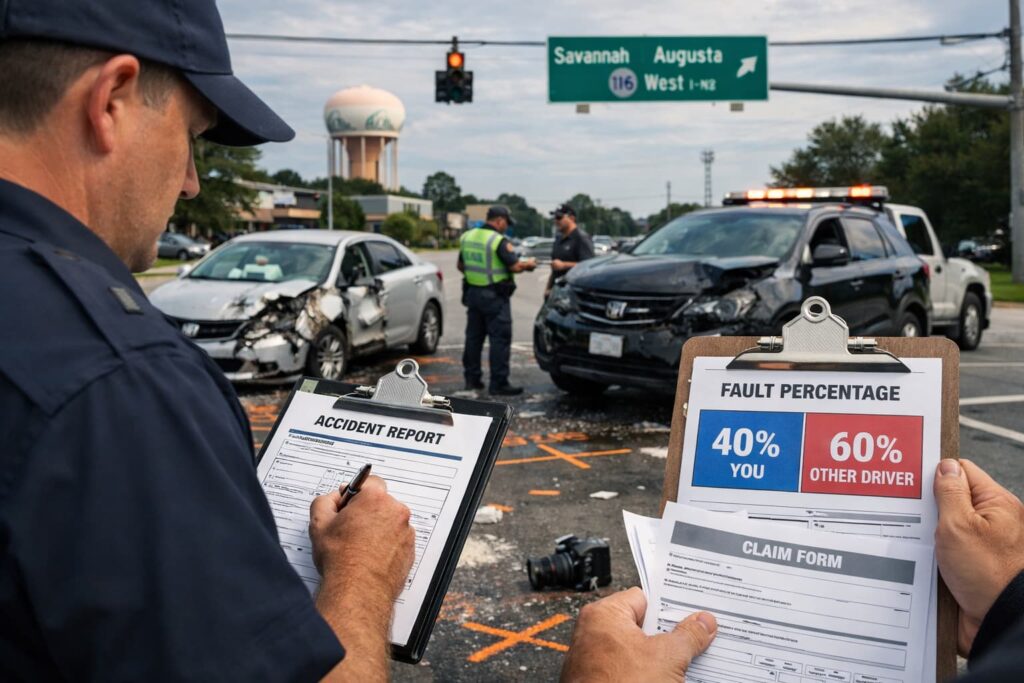
How Georgia’s 50% Fault Rule Works in Practice
Georgia’s modified comparative negligence rule applies to all personal injury cases, including car accidents, slip and falls, motorcycle crashes, and pedestrian accidents. Understanding the math behind fault reduction helps you evaluate settlement offers.
The Mathematical Impact of Fault Percentages
| Your Fault Percentage | Total Damages | Compensation Reduction | Final Compensation You Receive |
|---|---|---|---|
| 0% | $100,000 | $0 | $100,000 |
| 10% | $100,000 | $10,000 | $90,000 |
| 20% | $100,000 | $20,000 | $80,000 |
| 30% | $100,000 | $30,000 | $70,000 |
| 40% | $100,000 | $40,000 | $60,000 |
| 49% | $100,000 | $49,000 | $51,000 |
| 50% or more | $100,000 | 100% (barred) | $0 (no recovery allowed) |
When courts determine you are less than 50% at fault, your compensation gets reduced by your exact fault percentage. If your total damages equal $100,000 and you are found 20% at fault, you recover $80,000. If you are 30% at fault, you recover $70,000.
This proportional reduction applies to all damages, including medical bills, lost wages, pain and suffering, and future losses. Every percentage point of fault costs you money directly.
The Critical 50% Threshold
Being exactly 50% at fault or more eliminates your right to recover negligence damages from the other party. A victim who is 49% at fault recovers 51% of their damages. A victim who is 50% at fault recovers nothing.
Insurance companies push hard to reach this 50% threshold when liability is disputed. Crossing that line means their insured is no longer legally obligated to pay you damages in that claim, regardless of your injury severity.
Recent Changes in Georgia Tort Law
Recent tort-reform changes in Georgia also affect how safety-related conduct may be used in fault and causation arguments for newer cases. For causes of action arising on or after April 21, 2025, evidence of certain safety choices, such as not using required safety equipment, may be admissible specifically on issues of negligence, comparative negligence, causation, and apportionment of fault, making evidence rules an important part of your case strategy.
Real-World Examples
Consider a car accident at Abercorn Street and Victory Drive in Savannah. Driver A runs a red light. Driver B was speeding 10 mph over the limit. Driver A’s red light violation likely constitutes greater fault, but Driver B’s speeding could still result in some percentage of comparative fault being assigned, reducing but not eliminating Driver B’s recoverable damages.
In a slip and fall example at a Macon shopping center, a customer trips on a torn floor mat that the store knew about but did not fix. The customer was texting while walking. The store’s failure to repair a known hazard likely constitutes primary fault. The customer’s distraction could still lead to some percentage of comparative fault being assigned, depending on how the fact-finder views each party’s conduct.
How Courts Determine Fault Percentages
Fault determination involves evaluating all evidence to assign responsibility percentages to each party. Courts consider multiple factors when deciding how much fault each party bears.
Evidence That Establishes Fault
Several types of evidence help courts determine fault percentages in Georgia personal injury claims:
- Police reports documenting traffic violations, witness statements, and officer observations
- Witness testimony from neutral third parties who saw the accident occur
- Traffic camera footage, security video, or dashcam recordings showing what happened
- Accident reconstruction analysis by experts who evaluate physical evidence
- Physical evidence, including skid marks, vehicle damage patterns, and debris fields
- Cell phone records that prove distracted driving at the time of the crash
Strong evidence that clearly establishes that the other party’s negligence significantly outweighs any minor actions on your part counters inflated fault allegations. Comprehensive evidence gathering immediately after accidents preserves proof before it disappears.
Traffic Law Violations and Their Impact
Violating traffic laws creates strong evidence of negligence in Georgia. Running red lights, speeding, failing to yield right-of-way, following too closely, and improper lane changes all establish fault.
When one party clearly violated traffic laws and the other did not, courts typically assign primary fault to the violator. Minor violations like slightly exceeding speed limits might result in small comparative fault percentages. Major violations like drunk driving establish substantial fault.
Common Scenarios Where Comparative Negligence Applies
Comparative negligence affects many types of accidents. Understanding how fault allocation works in different scenarios helps victims recognize whether insurers are fairly evaluating their claims.
Car Accident Fault Scenarios
Rear-end collisions typically establish clear fault against the following driver who failed to maintain a safe distance. However, if the lead vehicle had non-functioning brake lights, comparative negligence might apply.
Left-turn accidents at intersections raise complex fault issues. The turning driver typically bears primary fault for failing to yield. However, if the oncoming driver was speeding excessively or ran a red light, fault becomes shared.
Slip and Fall Comparative Negligence
Property owners owe duties to maintain reasonably safe premises. However, visitors must also exercise reasonable care for their own safety. Comparative negligence applies when both parties failed in their respective duties.
If a grocery store in Augusta fails to clean up a spill promptly and a customer falls, the store bears primary fault. If the customer was running through the store while texting, a court or jury could assign a significant share of fault to the customer, depending on the evidence.
Motorcycle Accident Fault Issues
Car drivers who failed to see motorcyclists often claim the motorcyclist was speeding or weaving through traffic. However, drivers bear duties to watch for all vehicles, including motorcycles.
How Insurance Companies Use Comparative Negligence Against You
Insurance adjusters understand Georgia’s 50% rule and use comparative negligence strategically to reduce what they pay or eliminate liability entirely. Recognizing these tactics helps you protect your rights.
Exaggerating Your Fault Percentage
Adjusters may inflate your fault percentage beyond what evidence supports. They might make broad accusations suggesting you were distracted, not paying attention, or driving unsafely based on little or no actual evidence.
These exaggerated fault claims aim to reduce settlement values or reach the 50% bar that eliminates their payment obligations. Without legal representation, victims often accept these inflated fault percentages because they do not know how to counter them.
Blaming Victims for Unavoidable Conditions
Insurance companies may blame victims for road conditions, weather, or circumstances beyond their control. They might argue you were driving too fast for conditions even when you were traveling the speed limit.
These blame-shifting arguments attempt to assign fault for conditions you did not create and could not avoid. Courts recognize that victims need not anticipate that others will break traffic laws or act negligently.
Making Early Settlement Offers
Adjusters contact injured people quickly, making settlement offers before victims understand Georgia’s comparative negligence rules or their claim’s true value. These early offers include inflated fault percentages that victims might not recognize as unfair.
Once you accept a settlement and specific fault percentages, you cannot later challenge those percentages or pursue additional compensation.
Proving the Other Party’s Greater Fault
Successfully pursuing Georgia personal injury claims when comparative negligence applies requires proving the other party’s negligence significantly outweighed any minor contributory actions on your part.
Accident Reconstruction Analysis
Complex accidents benefit from professional accident reconstruction. These experts analyze physical evidence, vehicle damage, skid marks, and impact forces to determine how accidents occurred and who violated traffic laws.
Reconstruction reports provide an objective analysis that counters insurance company blame-shifting. When reconstruction clearly shows the other party caused the accident through specific negligent actions, fault percentages shift heavily in your favor.
Witness Testimony Value
Neutral third-party witnesses who saw accidents occur provide powerful testimony establishing fault. Their accounts may directly contradict self-serving statements from at-fault parties or insurance company theories.
When multiple witnesses describe the same events, your case strengthens significantly. When three independent witnesses all state that the other driver ran a red light, comparative negligence arguments lose force.
Protecting Your Rights in Comparative Negligence Cases
Steps you take after accidents directly impact how courts ultimately determine fault percentages. Once you are home and safe after receiving medical care, focus on protecting your legal rights.
Document Everything Thoroughly
Keep detailed records of everything related to your accident and injuries. Save all medical records, bills, prescription receipts, and therapy invoices. Document missed work days and lost income with employment records.
Maintain a journal noting your pain levels, limitations, treatment appointments, and how injuries affect your daily activities. This comprehensive documentation proves injury severity and establishes the full extent of damages.
Avoid Admitting Fault
Do not make statements accepting blame or responsibility at accident scenes or to insurance adjusters. Phrases like “I’m sorry” or “I should have been more careful” may be interpreted as an admission of fault.
Stick to factual descriptions of what happened without speculating about responsibility. Let evidence and legal analysis determine fault percentages.
Consult an Attorney Before Settling
Insurance companies make settlement offers at specific fault percentages long before you understand your claim’s true value. These offers might include exaggerated fault allocations that reduce what you receive.
Consulting an attorney before accepting any settlement protects you from agreeing to unfair fault percentages or inadequate compensation.