
Georgia’s comparative fault law surprises many accident victims who assume any contribution to a crash eliminates their right to compensation. This misconception leads people to accept lowball settlements or abandon valid claims entirely, believing their own mistakes disqualify them from recovery. The reality under Georgia law is more nuanced and frequently more favorable than injured drivers expect.
The question of shared fault comes up constantly in Augusta-area crashes. A driver who checked their phone briefly before a collision on Washington Road, someone who exceeded the speed limit slightly when another car ran a red light, a motorist who braked suddenly on Bobby Jones Expressway before being rear-ended: each wonders whether their imperfect behavior costs them everything. Georgia’s modified comparative negligence system answers this question with a specific mathematical threshold that determines who recovers and how much.
Key Takeaways for Georgia Comparative Fault Law
- Georgia bars recovery only when your fault reaches 50% or more under O.C.G.A. § 51-12-33, meaning drivers who are 49% responsible may still pursue compensation.
- Your compensation decreases proportionally to your fault percentage, so a driver found 30% at fault recovers 70% of their total damages.
- Insurance adjusters may inflate fault allegations to reduce what they pay, making independent evidence gathering critical to protecting your claim.
- Fault percentages aren’t fixed by police reports or initial assessments, and additional investigation may shift the allocation significantly.
- Georgia’s rule differs from neighboring states, with South Carolina allowing recovery up to 50% fault, creating potential confusion for border-area residents.
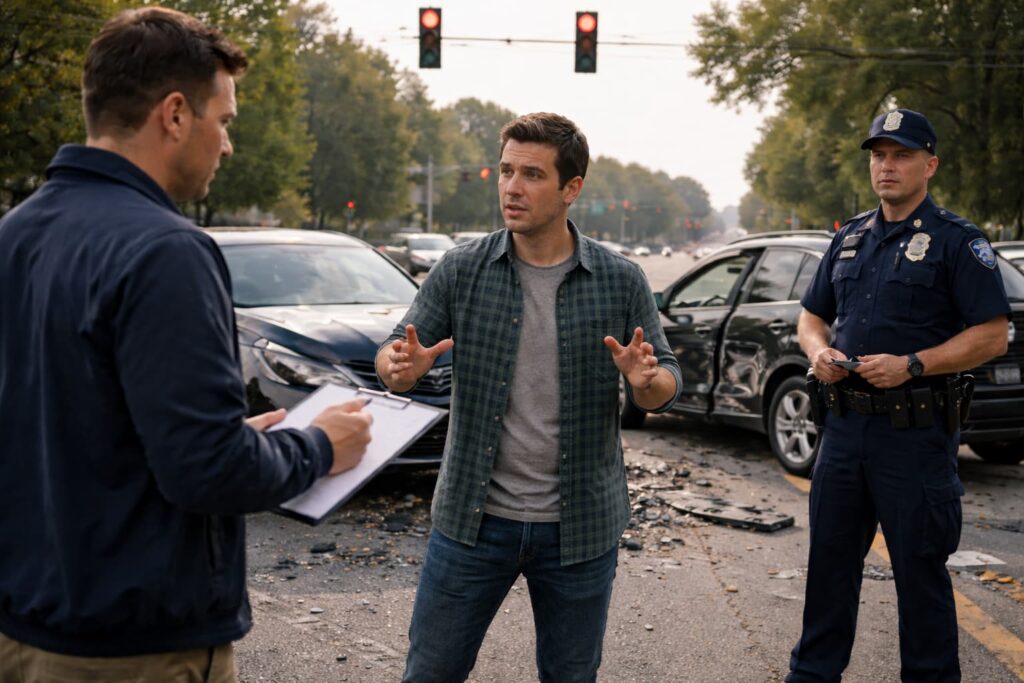
The 50% Threshold Explained Simply
Georgia uses what lawyers call “modified comparative negligence with a 50% bar.” This technical phrase describes a straightforward concept: you recover compensation as long as you weren’t equally or more responsible than everyone else combined.
Where the Line Falls
Picture fault as a scale from 0% to 100%. Georgia draws a hard line at 50%. Drivers at 49% fault or below may recover damages, reduced by their percentage. Drivers at 50% or above recover nothing, regardless of how serious their injuries are or how much the other driver contributed.
This threshold creates dramatic consequences around the boundary. A driver found to be 49% responsible recovers 51% of their damages. That same driver found to be 50% responsible recovers zero. The single percentage point difference may represent tens of thousands of dollars, making accurate fault determination enormously consequential.
| Your Share of Fault | Are You Allowed to Recover? | How Much You Recover | What It Means in Practice |
| 0% | ✅ Yes | 100% of damages | The other party bears full responsibility. |
| 10% | ✅ Yes | 90% of damages | Minor contribution reduces recovery slightly. |
| 25% | ✅ Yes | 75% of damages | Common in rear-end or merging disputes. |
| 40% | ✅ Yes | 60% of damages | Still a substantial recovery, but fault arguments matter. |
| 49% | ✅ Yes | 51% of damages | The highest possible recovery before the cutoff. |
| 50% | ❌ No | $0 | You are barred from compensation entirely. |
| 60%+ | ❌ No | $0 | Georgia law treats you as primarily responsible. |
How the Math Actually Works
Assume a crash on I-20 near Augusta leaves you with $100,000 in damages for medical bills, lost wages, and pain and suffering. Investigation determines you bear 25% fault for following too closely, while the other driver bears 75% fault for an unsafe lane change.
Your recovery is reduced by your 25% contribution, leaving $75,000 available. The reduction applies regardless of damage amount. Whether your injuries total $10,000 or $500,000, the 25% reduction operates identically.
Common Augusta Scenarios Where Fault Gets Shared
Shared fault situations arise constantly on Augusta-area roads. Traffic patterns around Fort Eisenhower, commercial vehicle congestion, and the mix of local and through-traffic create conditions where multiple drivers contribute to collisions.
The Sudden Braking Dispute
A driver on Gordon Highway stops abruptly when traffic ahead slows unexpectedly. The following driver rear-ends them. Traditional assumptions hold the rear driver entirely responsible, but circumstances complicate this picture.
If the lead driver braked without warning for no legitimate reason, or failed to maintain working brake lights, or stopped in a travel lane unnecessarily, they may share fault. The rear driver’s following distance matters too. Both parties’ conduct gets evaluated, with fault distributed based on how each contributed to the collision.
The Disputed Lane Change
Two vehicles collide while both attempt to merge into the same lane on Bobby Jones Expressway. Each driver claims the other initiated the dangerous move. Physical evidence, witness accounts, and damage patterns help reconstruct who moved first and how each driver responded.
These collisions rarely produce clear single-party fault. One driver might bear 60% responsibility for initiating an unsafe merge while the other bears 40% for failing to yield when the conflict became apparent. The 60% driver recovers nothing under Georgia law. The 40% driver recovers 60% of their damages.
The Intersection Conflict
A left-turning vehicle collides with an oncoming car at Wrightsboro Road. The turning driver failed to yield. But the oncoming driver exceeded the speed limit significantly, reducing their reaction time and ability to avoid the collision.
Georgia courts have addressed similar scenarios repeatedly. The turning driver’s failure to yield doesn’t automatically absorb 100% of fault. The speeding driver’s excessive velocity may contribute 20%, 30%, or more depending on circumstances. Both drivers’ choices factor into the final allocation.
Why Insurance Companies Push Fault Onto You
Adjusters working for the other driver’s insurance company have financial incentives to attribute fault to you. Every percentage point they shift in your direction reduces their company’s payment proportionally. Pushing you to 50% eliminates their obligation entirely.
The Recorded Statement Trap
Shortly after a crash, an adjuster may request a recorded statement about what happened. These conversations seem routine but carry significant risk. Statements made while shaken, in pain, or before fully understanding what occurred become permanent evidence.
Adjusters listen for any admission suggesting you contributed to the collision. “I didn’t see them until the last second” becomes evidence of inattention. “Maybe I was going a little fast” transforms into excessive speeding. These fragments, removed from context, support inflated fault allegations later.
Selective Evidence Interpretation
Insurance investigators examine available evidence looking for support for their desired conclusions. A police report noting you weren’t wearing a seatbelt becomes relevant to fault, even when seatbelt use didn’t cause the collision. Damage to your vehicle’s front corner suggests you made contact first, implying you caused the crash.
This selective interpretation isn’t necessarily dishonest, but it serves the insurer’s interests rather than accuracy. Counterbalancing this perspective requires gathering evidence that supports your account and challenges unfavorable characterizations.
The Leverage Play
As fault disputes develop, some adjusters may indicate they’ll assign you 50% or more fault if you don’t accept their offer. This positioning uses Georgia’s threshold rule as leverage. Accept their settlement, or they’ll ensure you recover nothing.
This tactic sometimes reflects a genuine belief about fault allocation. Other times it’s negotiation pressure. Distinguishing between these requires evaluating the actual evidence rather than accepting the adjuster’s characterization.
Building Evidence to Challenge Fault Allegations
Protecting your recovery percentage requires evidence that documents what actually happened, independent of what interested parties claim.
Physical Evidence at the Scene
Vehicle damage patterns reveal information about collision angles, speeds, and impact sequence that driver accounts may contradict or obscure. Photographs capturing all vehicles from multiple angles, skid marks on the roadway, debris distribution, and final rest positions create a record that supports reconstruction efforts.
Critical physical evidence to document includes:
- Damage to all vehicles showing impact points and severity
- Skid marks indicating braking efforts and vehicle paths
- Road conditions, including wet pavement, debris, or visibility obstructions
- Traffic control devices and their visibility from each approach
- Sight lines demonstrating what each driver could see before impact
This evidence exists briefly. Road crews clean debris. Vehicles get towed and repaired. Weather obscures marks. Capturing documentation quickly preserves information that might otherwise disappear.
Witness Perspectives
Independent observers see collisions differently than involved drivers. Someone in a parking lot, another motorist who avoided the crash, or a pedestrian on the sidewalk may have watched events unfold without the stress and limited perspective that affects participants.
Witness accounts carry particular weight when they contradict the other driver’s version. An uninvolved observer who saw the other driver run a red light provides powerful evidence regardless of what that driver claims. Collecting contact information for anyone who stopped or observed the crash enables follow-up before memories fade.
Electronic Data Sources
Modern vehicles contain event data recorders that capture speed, braking, and other information in the seconds surrounding collisions. Most newer vehicles include these systems, though accessing the data requires technical capability and sometimes legal process.
Traffic cameras, business security systems, and dashcams from other vehicles may have recorded relevant footage. This evidence answers questions about vehicle speeds, traffic signal status, and the collision sequence that witness memories and damage patterns may leave ambiguous.
How Fault Percentages Get Determined
No single authority assigns fault percentages that bind everyone. Police officers, insurance adjusters, attorneys, and ultimately juries each evaluate evidence and reach conclusions that may differ substantially.
The Police Report’s Limited Role
Officers responding to Augusta-area crashes create reports documenting their observations and conclusions. These reports carry weight but don’t conclusively establish fault for civil liability purposes. Officers arrive after collisions conclude, reconstructing events from evidence and statements rather than direct observation.
A police report assigning you partial fault doesn’t prevent you from challenging that assessment. Additional evidence, witness testimony, or reconstruction analysis may support different conclusions. Similarly, a report favoring you doesn’t guarantee insurance companies will accept that finding.
Insurance Company Assessments
Each insurer involved conducts its own investigation and reaches its own fault conclusions. The other driver’s company evaluates evidence, looking for reasons to minimize their exposure. Your company, if you have collision coverage, evaluates for their own purposes.
These assessments frequently conflict. One company might find you 30% at fault while another assigns you 45%. Neither conclusion binds the other or prevents further dispute. Settlement negotiations involve reconciling these competing evaluations or proceeding to litigation for a binding determination.
Jury Determination
When cases proceed to trial, jurors evaluate evidence and assign fault percentages. This determination becomes binding on the parties. Jurors hear testimony, examine physical evidence, and apply their judgment about what happened and who bears responsibility.
Jury verdicts are somewhat unpredictable. Different jurors viewing identical evidence may reach different conclusions. This uncertainty affects settlement negotiations, as both sides consider what a jury might decide rather than what they believe the evidence shows.
Strategies for Protecting Your Recovery Percentage
Several approaches help minimize your assigned fault percentage and increase available recovery.
Careful Communication
Everything you say about the accident becomes potential evidence. Apologizing at the scene, speculating about what you might have done differently, or casually mentioning your speed all may be recorded and used against you. Sticking to factual statements about what happened, without speculation or self-blame, protects against providing ammunition for fault arguments.
This doesn’t mean being dishonest. Accurate, limited statements serve better than expansive discussions that introduce unnecessary complications. Describing the collision sequence factually differs from analyzing whether you might have avoided it.
Prompt Evidence Preservation
Evidence favoring your position exists only if you capture it. Photographs, witness contact information, and notes about what you observed all require action shortly after the crash. Waiting allows evidence to disappear, memories to fade, and the other side’s version to solidify without challenge.
Preservation also means protecting evidence you don’t control. A letter requesting that businesses preserve surveillance footage, a formal request for the other driver’s vehicle data, or notification to insurers about electronic evidence all prevent spoliation, the destruction of relevant materials.
Independent Investigation
Insurance company investigations serve insurance company interests. An Augusta car accident lawyer conducting an independent investigation gathers evidence from your perspective, identifies witnesses the other side might overlook, and develops a reconstruction analysis supporting your account.
This investigation may reveal information that shifts fault allocation significantly. A witness the police didn’t interview, traffic camera footage the insurance company didn’t request, or vehicle data contradicting the other driver’s claimed speed all strengthen your position against inflated fault allegations.
FAQ for Georgia’s Comparative Fault Law
What if fault percentages from different sources don’t add up to 100%?
Fault among all parties must total 100% in the final determination. If you’re 25% at fault, the remaining 75% gets distributed among other responsible parties, which might include multiple drivers, a vehicle manufacturer, or a government entity responsible for road conditions. Cases with numerous potentially liable parties require careful analysis of each party’s contribution.
Does Georgia consider non-driver factors when assigning fault?
Yes. Road conditions, traffic signal malfunctions, vehicle defects, and other non-driver factors may absorb fault percentage that would otherwise fall on the drivers involved. A collision caused partly by obscured signage might assign 20% fault to the responsible government agency, reducing what the drivers collectively bear.
How does Georgia handle fault when one driver violated a traffic law?
Traffic violations create what courts call “negligence per se,” meaning the violation automatically establishes negligence. However, this doesn’t automatically assign 100% fault. A driver who ran a red light clearly violated traffic law, but if the other driver was speeding significantly, both violations contributed to the collision and both affect fault allocation.
What happens if the other driver lies about what happened?
Conflicting accounts are common, and insurance companies don’t simply accept whichever driver speaks first or loudest. Physical evidence, independent witnesses, and electronic data help establish what actually occurred regardless of driver statements. Demonstrating inconsistencies in the other driver’s account undermines their credibility.
Your Mistake Doesn’t Erase Their Responsibility
Sharing some fault for a crash doesn’t eliminate your right to compensation under Georgia law. The critical question isn’t whether you were perfect, but whether your contribution stays below the 50% threshold. Insurance companies benefit from your assumption that any fault destroys your claim. Fighting for fair compensation requires challenging inflated fault allegations with evidence documenting what actually happened.
Jamie Casino Injury Attorneys represents accident victims throughout Augusta, Martinez, Evans, and the CSRA region who face disputed fault claims. Our team investigates collisions thoroughly, gathers evidence supporting accurate fault allocation, and challenges exaggerated blame percentages. We handle these cases on a contingency basis, meaning you pay no attorney fees unless we recover compensation.
If you’re being blamed for a crash and aren’t sure whether you still have options, contact our office for a free consultation.