
Navigating the aftermath of crashes at one of South Carolina’s most notorious highway interchanges often requires the help of a Columbia car accident lawyer. The I-20/I-26/I-126 convergence, locally known as “Malfunction Junction,” earned its nickname through decades of dangerous design, confusing lane patterns, and frequent collisions that leave drivers facing serious injuries and complex insurance disputes.
Columbia’s interstate system funnels thousands of daily commuters from Lexington, Irmo, West Columbia, and Cayce through this problematic interchange. The combination of sudden lane changes, abrupt slowdowns, heavy truck traffic, and drivers unfamiliar with the area creates conditions that produce multi-vehicle accidents with disputed liability. Understanding your rights after a crash on these roads helps protect your ability to pursue compensation under South Carolina law.
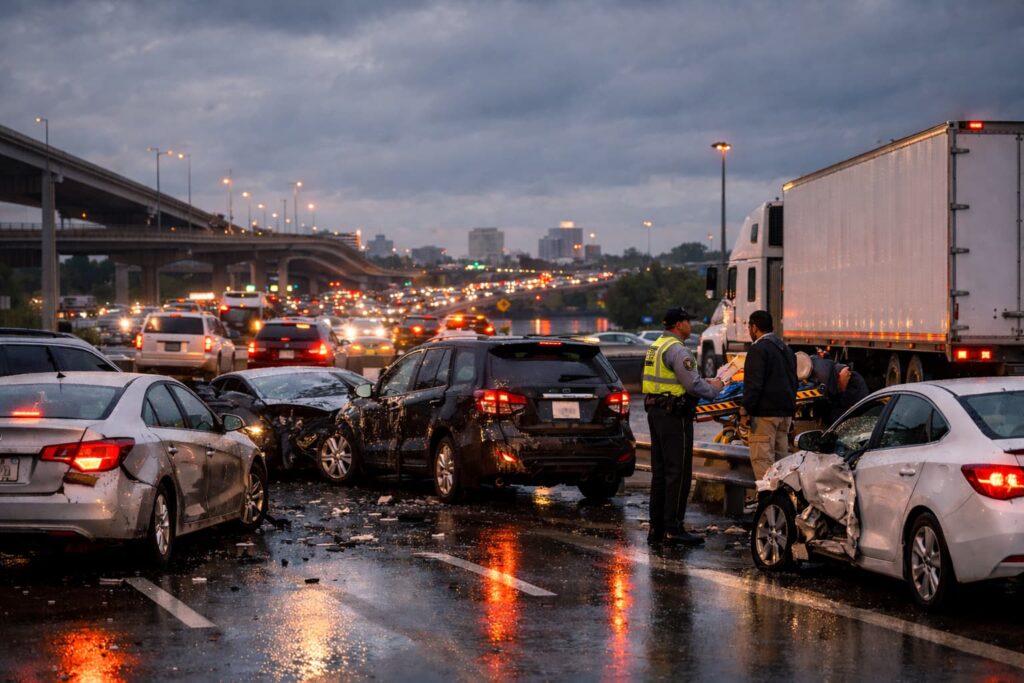
Key Takeaways for Columbia Interstate Accident Claims
- South Carolina follows a modified comparative negligence rule under S.C. Code § 15-38-15, allowing you to recover damages only if your fault is 50% or less.
- Malfunction Junction’s design creates unique crash patterns, including chain-reaction collisions, lane-change accidents, and sudden-stop rear-end crashes that complicate fault determinations.
- South Carolina’s statute of limitations for most personal injury claims is three years from the date of injury, except for claims against government entities, which may have shorter notice requirements and different deadlines.
- Your South Carolina Highway Patrol or Columbia Police accident report provides critical documentation of officer observations and preliminary fault assessments.
- Multi-vehicle interstate accidents often involve multiple insurance companies with conflicting liability conclusions, making thorough documentation particularly important.
Why Malfunction Junction Lives Up to Its Name
The I-20/I-26/I-126 interchange presents drivers with a confusing series of lane changes, exits, and merges compressed into a short stretch of highway. Understanding why this area produces so many accidents helps explain the complexity of claims arising from crashes here.
Design Challenges Creating Danger
Malfunction Junction requires drivers to make critical navigation decisions quickly while traveling at interstate speeds. Motorists heading from I-26 toward downtown Columbia must cross multiple lanes of traffic within a short distance. Those merging from I-20 face similar challenges as lanes shift and exit ramps appear suddenly.
The interchange’s original design predates modern traffic engineering standards. While ongoing improvements have addressed some issues, the fundamental geometry continues to create dangerous conditions during peak traffic hours.
Common Crash Patterns in the Interchange
Certain accident types occur repeatedly at Malfunction Junction due to its specific design problems. These patterns help explain how crashes happen and who may bear responsibility.
Frequent crash scenarios include:
- Lane-change collisions when drivers cut across multiple lanes to reach exits
- Rear-end crashes caused by sudden traffic slowdowns near merge points
- Sideswipe accidents during aggressive merging maneuvers
- Chain-reaction pileups when one collision triggers additional impacts
- Truck-involved crashes near the Bush River Road and Harbison exits
Each of these scenarios creates different liability questions. Multi-vehicle crashes prove particularly challenging because the sequence of impacts affects who bears responsibility for each driver’s damages.
| Crash Scenario at Malfunction Junction | Why It Happens | Key Evidence to Preserve | Liability Challenges |
| Lane-change collisions | Drivers must cross multiple lanes quickly to reach exits | Dashcam footage, vehicle damage angles, witness statements | Disputes over unsafe lane changes vs. failure to yield |
| Sudden-stop rear-end crashes | Stop-and-go congestion during rush hour | Brake marks, traffic conditions, vehicle spacing photos | Lead driver braking vs. following distance arguments |
| Sideswipe accidents | Aggressive merging near short on-ramps | Scrape patterns, lane positioning photos | Determining which vehicle left its lane |
| Chain-reaction pileups | One impact triggers multiple secondary collisions | Sequence-of-impact analysis, multi-vehicle photos | Apportioning fault among multiple drivers |
| Truck-involved crashes | Heavy commercial traffic near Bush River & Harbison exits | Truck logs, ECM data, maintenance records | Multiple liable parties (driver, carrier, contractor) |
Traffic Volume and Congestion Factors
Rush hour traffic through Malfunction Junction backs up predictably, creating stop-and-go conditions that increase rear-end collision risk. Commuters traveling between Lexington County and downtown Columbia pass through this interchange daily, along with through-travelers on I-20 and I-26.
The South Carolina Department of Transportation monitors traffic patterns throughout the Columbia area. Heavy congestion during morning and evening commutes, combined with the interchange’s design limitations, produces conditions where even attentive drivers may find themselves involved in crashes.
Medical Attention After a Columbia Interstate Crash
Seeking appropriate medical care protects both your health and your potential legal claim. Interstate crashes may cause injuries that don’t produce immediate symptoms, making prompt evaluation important even when you feel relatively fine.
Why Evaluation Matters Even Without Obvious Injuries
High-speed impacts subject your body to significant forces even in relatively minor collisions. Soft tissue injuries, concussions, and internal injuries may not cause noticeable symptoms for hours or days following an accident. Adrenaline and shock can initially mask pain.
A medical evaluation creates documentation connecting your injuries to the accident. This record becomes essential if you later pursue compensation. Gaps between the crash and your first medical visit give insurance companies opportunities to argue your injuries came from something other than the accident.
Symptoms Requiring Follow-Up Care
Certain warning signs commonly appear in the days following an interstate crash. Recognizing these symptoms helps you seek timely treatment.
Watch for these delayed symptoms:
- Headaches developing or worsening over several days
- Neck stiffness or pain that emerges gradually
- Back pain, especially in the lower spine
- Numbness or tingling in arms or legs
- Dizziness, confusion, or difficulty concentrating
- Sleep disturbances or mood changes
Medical professionals note that these delayed presentations often indicate injuries requiring treatment. Documenting when symptoms first appeared and seeking care promptly strengthens the connection between the accident and your condition.
Obtaining Your South Carolina Accident Report
The accident report created by responding officers contains valuable information about your crash. This document records the officer’s observations, witness statements, and preliminary conclusions about fault that influence how insurance companies evaluate claims.
Requesting Reports From Law Enforcement
Crashes on Columbia’s interstates may be investigated by South Carolina Highway Patrol, Columbia Police Department, or Richland County Sheriff’s Office, depending on the exact location. Officers provide incident numbers at the scene that you need to request your report later.
The South Carolina Department of Public Safety maintains records for Highway Patrol investigations. Reports typically become available within several days to a few weeks after the crash. Requesting your report promptly helps you understand how the investigating officer documented the accident.
Understanding Report Contents
Accident reports document several categories of information that may be relevant to your claim. Knowing what these reports contain helps you identify potential issues early.
Key information includes:
- Date, time, and precise crash location
- Weather and road conditions
- Names and insurance information for all drivers
- Witness contact information and statements
- The officer’s diagram of the accident scene
- Citations issued and preliminary fault assessment
The officer’s fault determination influences but doesn’t bind insurance companies or courts. If the report contains errors or you disagree with its conclusions, documenting your account of events becomes particularly important.
Protecting Your Claim After the Crash
The steps you take in the days following an accident significantly affect your ability to pursue compensation later. Careful attention to documentation and communication helps strengthen your claim.
Documentation Practices That Matter
Physical evidence and memories fade quickly after a crash. Preserving information promptly protects details you may need later.
Preserve your case by keeping all photographs from the scene or of your injuries, saving damaged clothing and personal items in their current condition, storing all paperwork including medical records and insurance correspondence, and backing up any dashcam footage from your vehicle. Written witness statements gathered while memories remain fresh are valuable if liability disputes arise later.
Insurance Communication Considerations
How you communicate with insurance companies affects your claim’s outcome. Adjusters from the at-fault driver’s insurance may contact you quickly, seeking statements they may use to minimize claim values.
Consider limiting initial conversations to exchanging basic information. Avoid recorded statements without understanding their implications. Don’t speculate about fault or the extent of your injuries before completing a medical evaluation. Many Columbia residents find that consulting with an attorney before detailed insurance discussions helps protect their interests.
South Carolina Fault Rules and Your Recovery
South Carolina’s approach to accident liability directly affects your ability to recover compensation. Understanding these rules helps you evaluate your claim and recognize when fault disputes require attention.
Modified Comparative Negligence Explained
South Carolina follows a modified comparative negligence system under S.C. Code § 15-38-15. This rule allows injured parties to recover damages as long as they bear 50% or less of the fault for the accident. Your recovery is reduced proportionally based on your assigned fault percentage.
For example, if your damages total $100,000 and you’re found 25% at fault, your recovery reduces to $75,000. If you’re found 51% or more at fault, South Carolina law bars any recovery from other parties. This threshold makes fault determination critically important.
Multi-Vehicle Crash Complications
Malfunction Junction pileups often involve three, four, or more vehicles. Each driver’s insurance company investigates independently, frequently reaching different conclusions about responsibility. One insurer may blame your lane change while another points to the driver who rear-ended you.
These disputes may delay resolution and require detailed accident reconstruction to sort out the sequence of events. Witness statements, physical damage patterns, and any available camera footage help establish what actually happened.
When Legal Help Strengthens Your Position
Not every fender-bender requires an attorney, but certain situations benefit significantly from legal representation. Recognizing when professional help adds value helps you make informed decisions.
Complex Liability Scenarios
Multi-vehicle accidents at Malfunction Junction frequently involve disputed fault among several parties. When insurance companies point fingers at each other, injured victims find themselves caught in the middle without a clear resolution.
A Columbia personal injury lawyer may help you fight for fair compensation in these complex scenarios. Legal representation is particularly valuable when liability remains genuinely disputed or when multiple insurance policies may provide coverage.
Serious or Lasting Injuries
Claims involving significant medical expenses, extended treatment, or permanent impairment carry higher stakes. Insurance companies often resist paying substantial claims without thorough documentation and persistent advocacy.
When injuries affect your ability to work, require ongoing medical care, or result in lasting limitations, the claim’s value extends beyond immediate medical bills. Understanding how to document and present these long-term impacts typically requires experience with similar cases.
Insurance Company Resistance
Insurance adjusters employ various strategies to minimize claim payouts. Quick settlement offers made before you understand your injury’s full extent, repeated requests for documentation, and surveillance all serve the company’s interest in reducing what they pay.
Legal representation helps level the playing field when you’re dealing with experienced insurance professionals. Attorneys understand these tactics and help clients avoid common mistakes that weaken claims.
Deadlines That Affect Your Claim
South Carolina imposes strict time limits on personal injury claims. Missing these deadlines may permanently bar your recovery, regardless of how strong your case otherwise appears.
The Three-Year Statute of Limitations
South Carolina’s statute of limitations for most personal injury claims gives you three years from the date of injury to file a lawsuit. This deadline functions like a countdown timer that runs regardless of whether settlement negotiations continue.
The three-year period may seem lengthy, but complex cases require time for medical treatment, investigation, and negotiation. Starting the claims process promptly preserves your options and avoids last-minute pressure.
Government Entity Exceptions
Crashes involving government vehicles or road defects may involve claims against state or local government entities. These claims require specific notice procedures and often have shorter deadlines than standard accident cases.
If your accident involved a government employee or potentially negligent road design or maintenance, consulting an attorney promptly helps you meet applicable deadlines and procedural requirements.
FAQ for Columbia Interstate Accident Claims
How do I know which law enforcement agency investigated my crash?
The agency depends on the crash location. South Carolina Highway Patrol typically investigates interstate accidents, while Columbia Police or Richland County Sheriff may respond to crashes on adjacent surface streets. Your incident paperwork from the scene identifies the responding agency and provides the report number needed to request copies.
What if the other driver’s insurance denies my claim entirely?
A denial doesn’t necessarily end your options. Denials sometimes result from disputed liability, coverage questions, or insufficient documentation. You may provide additional evidence supporting your claim, request reconsideration, or pursue legal action if the denial appears unjustified. Understanding the specific denial reason helps you determine appropriate next steps.
Does dashcam footage help prove fault in Malfunction Junction crashes?
Video evidence often proves valuable in disputed liability cases, particularly at complex interchanges where crash sequences happen quickly. Your dashcam footage, footage from other vehicles, or recordings from nearby businesses may capture details that witness memories miss. Preserve any footage immediately, as storage devices may overwrite older recordings.
What happens if the at-fault driver lacks sufficient insurance coverage?
South Carolina requires minimum liability coverage that is often inadequate for serious interstate accidents. Your own underinsured motorist coverage may help bridge the gap when the at-fault driver’s policy limits fall short of your damages, provided your policy includes underinsured motorist coverage. Reviewing your own policy helps you identify available coverage sources.
How do crashes involving commercial trucks differ from regular car accidents?
Truck accidents involve additional complexity, including federal regulations from the Federal Motor Carrier Safety Administration, multiple potentially liable parties, and specialized evidence. Trucking companies may preserve or destroy evidence quickly, making early investigation important. These claims often require analysis of driver logs, maintenance records, and Electronic Control Module (ECM) data from the truck’s onboard computer.
Your Path Forward After a Columbia Interstate Crash
Crashes at Malfunction Junction and along Columbia’s interstate system create challenges that extend well beyond vehicle damage. The confusion of multi-vehicle accidents, the stress of dealing with multiple insurance companies, and the uncertainty about your injuries all demand attention during an already difficult time.
Jamie Casino Injury Attorneys represents crash victims throughout Columbia, Lexington, Irmo, and the South Carolina Midlands. Our team understands the unique challenges of interstate accident claims and fights for fair compensation when insurance companies undervalue legitimate injuries. We handle car accident cases on a contingency basis, meaning you pay no attorney fees unless we recover compensation.
If you were injured in a crash on I-20, I-26, or anywhere in the Columbia area, contact our office for a free consultation.